Singapore shares fall as regional markets track Wall Street losses
The STI ended 0.4% lower on Nov 23 as banks slipped and broader market decliners outnumbered advancers.
Top-rated brokers
Compare all 9- 1
 XMBest overall for gold CFDsGold spread0.25Visit XM (opens in a new tab)
- 2
 XTBGold CFDs and real gold ETFsGold spread0.35Visit XTB (opens in a new tab)
- 3
 PepperstoneMost regulatorsGold spread0.05Visit Pepperstone (opens in a new tab)
CFDs are complex instruments and come with a high risk of losing money rapidly due to leverage. You should consider whether you understand how CFDs work and whether you can afford to take the high risk of losing your money.

Singapore equities finished lower on Monday (Nov 23), extending the previous week’s decline as weakness from Wall Street carried into Asian trading.
The Straits Times Index (STI) fell 0.4 per cent, or 21.36 points, to close at 4,953.81. Selling was broader than the benchmark suggested, with decliners ahead of gainers across the market as investors reacted to a weaker global equity backdrop.
For gold and XAU/USD traders, the session offered a snapshot of risk sentiment in Asia rather than a direct driver for bullion. Softer equities can sometimes affect demand for defensive assets, but the moves described on Monday were centred on stock markets.
STI extends decline
Across the broader Singapore market, 339 counters fell while 247 rose. Turnover reached 1.2 billion securities worth S$2.1 billion.
The day’s retreat followed losses in US equities at the end of the previous week. Stephen Innes, managing partner at SPI Asset Management, said Wall Street had left Asia with an “unpleasant parcel” at the start of Monday trading.
He also described the previous Friday’s US market damage as “extraordinary”, noting that the S&P 500 had entered correction territory. The Nasdaq 100 briefly crossed the traditional 20 per cent bear-market threshold from its October peak before recovering somewhat by the close.
That backdrop weighed on several regional bourses and left Singapore’s benchmark index on the defensive for another session.
Hongkong Land leads STI gainers
Hongkong Land was the strongest performer among STI constituents. The stock rose 2.4 per cent, or US$0.20, to US$8.59.
The move followed the property developer’s raised full-year profit guidance on Friday. Growth in its Hong Kong and mainland China portfolios helped lift underlying profit by 38 per cent for the third quarter ended Sep 30.
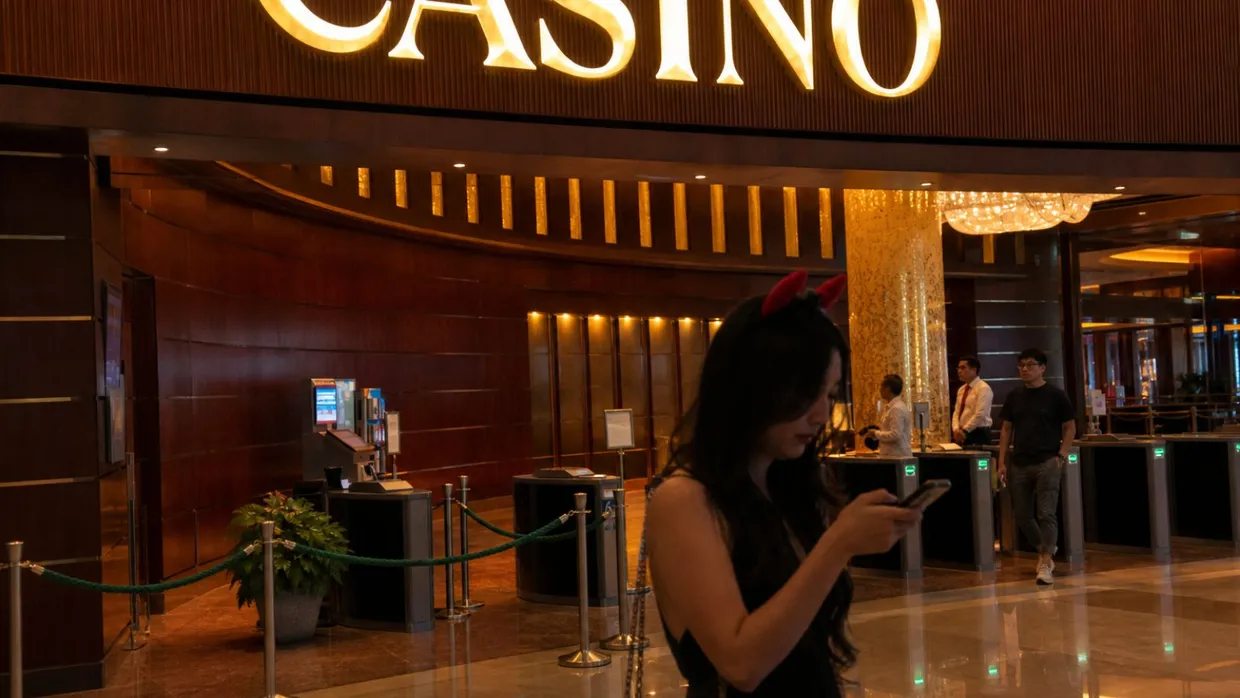
At the other end of the blue-chip index, Genting Singapore was the weakest STI component. Its shares fell 2.8 per cent, or S$0.015, to S$0.525.
The local banks also remained under pressure. DBS declined 0.5 per cent, or S$0.35, to S$65.76. OCBC slipped 0.5 per cent, or S$0.13, to S$26.41. UOB dropped 0.8 per cent, or S$0.28, to S$35.14.
Weakness in the banking names added to the drag on the STI, given their influence on the benchmark.
Broader market mixed within indices
Moves outside the STI showed a split between individual winners and losers even as the overall market tone stayed negative.
Within the iEdge Singapore Next 50 Index, CSE Global was the top gainer. The stock climbed 7.8 per cent, or S$0.055, to S$0.76.
Hong Leong Asia was the weakest name in that index, falling 6 per cent, or S$0.11, to S$1.73.
Regional benchmarks also ended lower. Hong Kong’s Hang Seng Index slipped 0.1 per cent, South Korea’s Kospi dropped 3.3 per cent, and the FTSE Bursa Malaysia KLCI declined 0.5 per cent.
The regional decline underscored how the weaker US lead shaped Monday’s Asian trading session, with Singapore joining other markets in closing in the red.